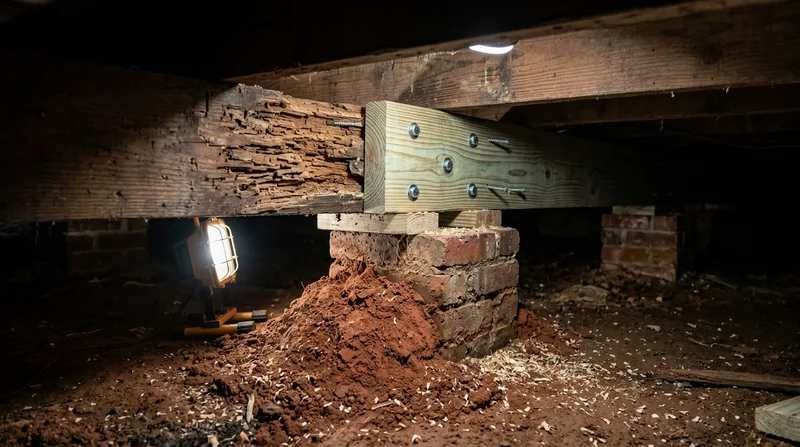




Sagging floors and soft spots in Raleigh's Victorian homes, Craftsman bungalows, and mid-century cottages almost always point to one of two culprits: termite-damaged floor joists and subfloor, or foundation movement driven by the region's expansive red clay soil. Floor joist and subfloor repair in Raleigh stops that sag, restores structural integrity, and gets your floors level again before new finishes go down. The Piedmont's humid subtropical climate, real termite pressure that runs most of the year, and seasonal swelling of clay soils create genuine demand for this work. We sister compromised joists, replace sections of subfloor where wood has softened, and rebuild the structure beneath your feet.
Why Floor Joist and Subfloor Repair Matters in Historic and Newer Raleigh Homes
Raleigh's building stock spans more than a century, from the largest intact Victorian neighborhood in the Southeast in historic Oakwood to the brick-veneer subdivisions ringing North Hills. Older homes rest on sill plates and rim joists that have faced decades of moisture, seasonal foundation movement, and termite activity. Newer construction is not immune either: poor drainage, plumbing leaks, or inadequate ventilation under a crawlspace can compromise joists and subfloor in any era. A soft or bouncy floor is not just uncomfortable; it signals that wood members are losing load-carrying capacity.
- Termite damage creates voids and tunnels in joists, reducing their cross-sectional strength and ability to carry floor loads.
- Dry rot and wood rot spread in damp crawlspaces or under sinks, turning solid wood into spongy material that cannot support weight.
- Foundation settlement or heave caused by clay soil expansion and contraction creates uneven support, stressing joists at new angles.
- Plumbing leaks and poor crawlspace ventilation soak subfloor and rim joists, accelerating decay and attracting further termite activity.
- Undersized or notched joists from past amateur repairs fail under normal floor loads and furniture weight.
Addressing these failures early prevents floors from worsening and keeps repair costs proportional to the damage. See our termite damage repair page for detail on how we assess and repair termite-compromised wood.
Key info: Raleigh's red clay soil swells when wet and shrinks when dry, moving foundations seasonally. This cyclic stress on sill plates and rim joists makes them prime candidates for rot and termite entry. Combined with real termite pressure year-round, floor joist failure is common in homes over 20 years old.
How We Repair Floor Joists and Subfloor in Raleigh: Step by Step
Our process begins with a thorough crawlspace inspection. We identify which joists are compromised by sounding them with a hammer, probing with a screwdriver, and measuring deflection with a level. We photograph the damage and explain what we see before proposing a repair path. Once you approve the scope, we shore up the floor with temporary supports, remove or sister the damaged joists, and rebuild subfloor sections with new pressure-treated lumber or solid-sawn stock matched to the existing framing.
- Access the crawlspace or basement and map all compromised joists and subfloor sections using a visual and tactile survey.
- Install temporary support posts and beams to carry the floor load safely while we work on the permanent repairs below.
- Sister new joists alongside damaged ones by bolting them together, or replace joists entirely if damage is too extensive for sistering to be effective.
- Remove and replace rotted or soft subfloor with new tongue-and-groove or plywood, fastened to the joists with ring-shank nails or screws.
- Remove temporary supports once the new structure is fully fastened and verified level, then patch the crawlspace access and any openings we made.
- Return to the living space above and verify floor levelness with a long straightedge, shimming or grinding high spots as needed before finishes are installed.
In a typical Raleigh Craftsman bungalow with two or three compromised joists and a small section of soft subfloor, the work takes one to three days. Larger jobs affecting an entire bay or multiple structural members may extend to a week.
Local example: A Hayes Barton home with a sagging master bedroom had three joists compromised by termite damage and two by dry rot near a failed gutter. We sistered two of the termite-damaged joists with pressure-treated Douglas fir, replaced the third entirely, and rebuilt 40 square feet of subfloor. The floor came level in two days, and the homeowner had new hardwood installed the following week.
Repair Methods: Sistering vs. Full Joist Replacement
| Approach | Description | Best for |
|---|---|---|
| Sistering | Install a new joist alongside a damaged one and bolt them together, creating a doubled member that carries the load. | Joists with partial damage (rot on one edge or face, termite damage in one section), where the remaining wood is still sound enough to bond with the new member. |
| Full Replacement | Remove the damaged joist entirely and install new lumber matched to the original size, species, and span, fastened at both ends. | Joists that are severely rotted, crushed, or notched; where damage spans more than half the joist length; or where sistering would not provide adequate load capacity. |
| Subfloor Patching | Cut out soft or rotted subfloor and install new plywood or tongue-and-groove, fastened to the underlying joists with ring-shank nails or screws. | Localized soft spots, water damage near plumbing penetrations, or areas where moisture has compromised the subfloor but joists remain sound. |
| Rim Joist and Sill Plate Repair | Sister or replace the rim joist (the outermost joist running around the perimeter) and repair or replace the sill plate where it rests on the foundation. | Homes with termite entry or rot at the foundation line; critical for load transfer and structural continuity, especially in older homes with settling foundations. |
We choose the method that gives you the best value and longevity. Sistering is faster and less invasive when the existing joist can support the repair; replacement is the honest answer when wood damage is too extensive.
Floor Joist and Subfloor Repair Cost in Raleigh: What to Expect
Floor joist and subfloor repair in Raleigh starts at $1,800 for a small job: one or two compromised joists, a localized area of soft subfloor, straightforward access. The cost moves up based on the number of joists involved, the total area of subfloor replacement, the depth of the crawlspace (shallow spaces cost more labor due to awkward working positions), and whether we need to replace rim joists or sill plates. Homes in Oakwood, Boylan Heights, or Cameron Park often have tighter crawlspaces and older framing that requires more careful work, which affects the final bill.
A mid-range repair (three to five joists, 60 to 100 square feet of subfloor, straightforward access) typically runs $3,500 to $5,500. Larger jobs affecting an entire bay, multiple structural members, or requiring engineered beam work or load-bearing wall considerations move into the $6,000 to $10,000 range or higher. We get the full picture on site before quoting, because hidden damage under insulation or behind blocking often changes the scope once we start.
The best approach is to get two or three estimates from local carpenters who will actually crawl the space and explain what they see. See our pricing page for more detail on what moves costs up or down, and call us at (984) 254-7340 for a free estimate with no obligation.
Floor Joist and Subfloor Repair Near Me: What Raleigh Homeowners Should Know When Hiring a Carpenter
Finding a carpenter who understands the specific pathologies of Raleigh's homes and climate is more important than finding the cheapest bid. Ask any contractor whether they carry insurance covering structural carpentry work and whether they have experience with termite-damaged joists, dry rot in crawlspaces, and foundation-related settling. Request references from recent jobs in your neighborhood; a carpenter who has worked in Oakwood or Hayes Barton knows the soil and the building stock. Verify that they understand local permitting requirements: some structural repairs require a permit and an inspection, and requirements vary by jurisdiction. Check whether your HOA (common in North Hills and newer subdivisions) has rules about access or crawlspace work.
When you get estimates, compare what each carpenter is proposing to repair or replace. A low bid that replaces every joist when sistering would work is not a bargain. A bid that does not mention how they will keep the floor level or how they will handle temporary support is incomplete. Call us at our contact page to discuss your floor with someone who has been doing this work in Raleigh since 2016.
Floor Joist & Subfloor Repair in Raleigh: Pricing Guide
| Service | Price | Details |
|---|---|---|
| Single joist or small subfloor patch | Starting at $1,800 | One or two compromised joists, less than 50 square feet of subfloor replacement, straightforward crawlspace access |
| Mid-range repair (multiple joists and subfloor) | $3,500 to $5,500 | Three to five joists, 60 to 100 square feet of subfloor, rim joist assessment, temporary support included |
| Large-scale or complex structural repair | On estimate | Entire floor bay, engineered beam work, load-bearing wall considerations, or multiple structural systems requiring coordination |
| Permit and inspection coordination | Included | We help document damage and coordinate with local building department; permit fees paid by homeowner |
| Travel throughout Raleigh area | Included | No separate mileage fee in Raleigh, Cary, Durham, Chapel Hill, Garner, and surrounding Wake County areas |
| Free estimate | No charge | Full crawlspace inspection, written scope, and pricing within 24 hours; call (984) 254-7340 to schedule |
Indicative pricing, the exact cost depends on square footage, finish, and site access. Free personalized estimate within 24h at (984) 254-7340.


